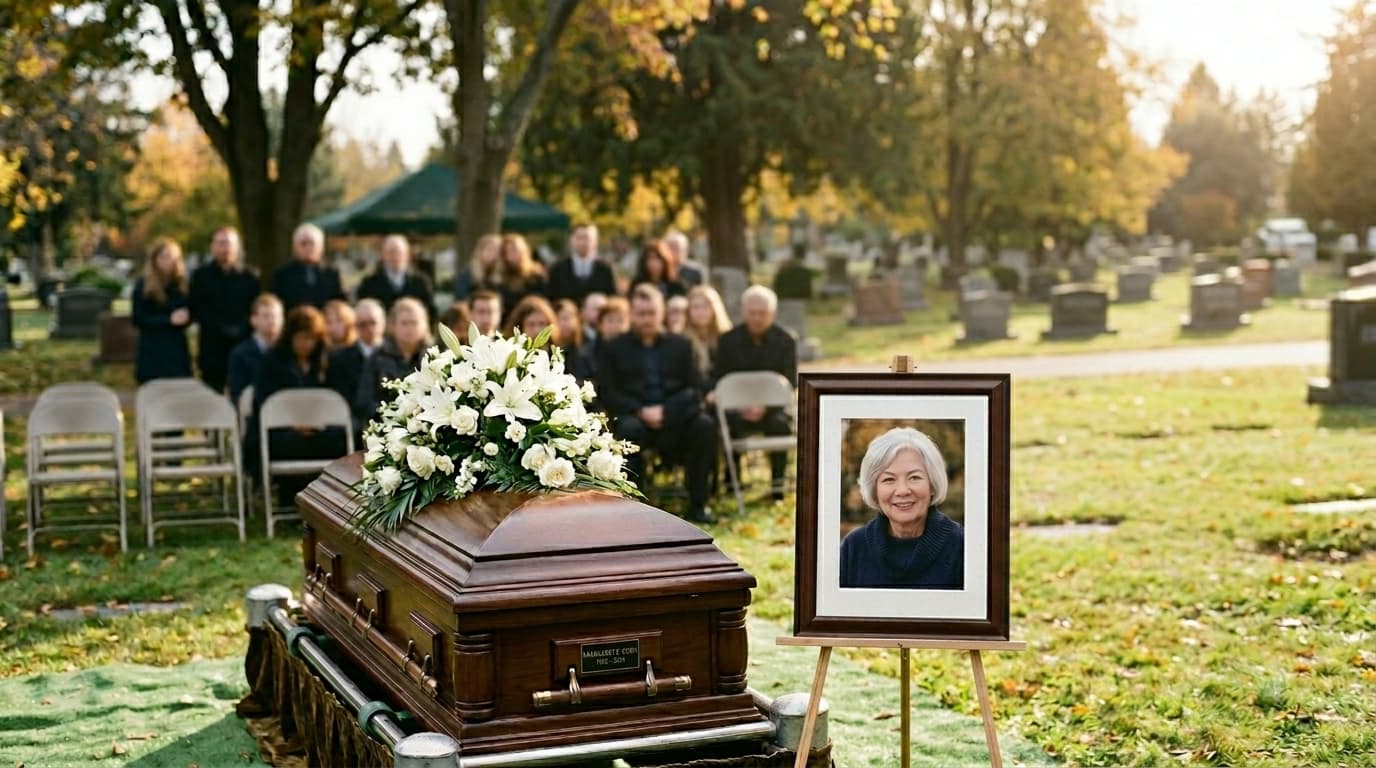
Choosing Music for Your Funeral: Yes, It's Okay to Have Opinions About This
The soundtrack to your goodbye is worth choosing on purpose. How to pick funeral music that reflects your life and fits each moment of the service.
Let's talk about something we all avoid thinking about until we're forced to: our own funerals. Specifically, the soundtrack.
I know, I know. You'd rather do almost anything else. But here's the thing—if you don't make these choices, someone else will. And that someone might think "My Heart Will Go On" is a tasteful choice. (No shade to Celine, but you might not want your loved ones ugly-crying to the Titanic theme while staring at your casket?)
The good news is that this doesn't have to be a grim, all-at-once project. Think of it less like writing a will and more like building the playlist of your life—the one that, played start to finish, tells the story of who you actually were. You've made playlists before. For road trips, for workouts, for that one ex you're definitely over. You can make this one too.
First, a Note on Tradition
Some religions have very prescribed funeral services—some filled with specific hymns and chants, others with no music at all. If your faith tradition has clear guidelines, this might be a shorter conversation for you, and that's perfectly fine. There's deep comfort in ritual, and those structures exist for good reason.
But if you have flexibility? If your service can be customized? Then pull up a chair. We have things to discuss. And worth knowing: you're not an outlier for wanting it personal. The National Funeral Directors Association has tracked a steady, years-long shift toward personalized services—families increasingly want a goodbye that reflects the actual person, not a template (NFDA consumer research). Music is one of the easiest and most powerful ways to do that.
Why This Actually Matters
Music does something words alone can't. It carries memory. The opening notes of a song can transport your daughter back to Saturday mornings making pancakes, or remind your best friend of that road trip where you both got spectacularly lost and somehow ended up at a goat farm.
This isn't just sentimental hand-waving, either. Music and autobiographical memory are wired together unusually tightly—a familiar song can pull up not just a memory but the feeling of being there, which is exactly why music reaches people even deep into dementia when most other cues have faded (AARP on music and memory). For the people in those pews, the right song won't just be background. It'll be a doorway.
Choosing your funeral music isn't morbid—it's a final gift. It's saying, This is who I was. This is what moved me. This is how I want you to remember our time together.
Build It Like a Story, Not a List
Here's the shift that makes this whole thing click: don't sit down and try to name "good funeral songs." That's how you end up with a generic, off-the-shelf service. Instead, build the playlist the way you'd tell your life story to someone who never got to meet you.
A few ways to find the songs that actually belong:
- Walk through the eras. Childhood, the teenage years, early adulthood, the long middle, now. What was playing? Not what should have been playing—what actually was. The song from your first slow dance. The album you wore out the summer you moved away from home. The artist your dad blasted while mowing the lawn.
- Map it to the people. A lot of your life lives in your relationships. Your wedding song. The lullaby you sang to your kids until they begged you to stop. The track you and your sister still text each other lyrics from. Each of these is a way of saying, you mattered to me, to the specific person who'll hear it.
- Mark the turning points. The song that got you through a hard year. The one playing when something finally clicked. The anthem you adopted after a loss, a recovery, a fresh start. These carry the weight of who you became.
The goal isn't a list of objectively great songs. It's a sequence that, if your grandkid listened to it in twenty years, would actually teach them something about you.
Some Approaches to Consider
The Traditional Route. Hymns, classical pieces, or religious music that reflects your faith. "Amazing Grace" has staying power for a reason. So does Pachelbel's Canon (though every wedding musician just shuddered). These choices signal comfort, continuity, and the sacred.
The Personal Anthology. Songs that meant something specific to you. Your wedding song. The lullaby you sang to your kids. That one track from your college years that still makes you feel 22 and invincible. These are conversation starters for those gathered—"Oh, she loved this song because..."
The Unexpected Choice. Maybe you want to go out to "Here Comes the Sun" or Louis Armstrong's "What a Wonderful World." Perhaps you're the person who genuinely wants "Highway to Hell" played at the end, and honestly? Own it. Laughter at a funeral isn't disrespectful; it's a release valve.
The Quiet Option. Some moments don't need music. Silence can be its own kind of honoring, giving space for private memory, for breathing, for simply being present with grief.
Most well-built services aren't purely one of these—they're a blend. A traditional opening, a deeply personal middle, one cheeky surprise near the end. The mix is the message.
Matching Songs to Moments in the Service
A funeral or memorial isn't one undifferentiated block of time. It has distinct moments, and each one wants a different kind of song. You don't need to fill every slot—but knowing the slots exist makes it easier to choose on purpose instead of by accident.
- The gathering / prelude. As people arrive and settle, this is quieter, atmospheric music. It sets the tone before anything formal begins. Instrumental or low-key vocal tracks work well here—nothing that demands attention yet.
- The entrance or opening. The first deliberate piece, often as people are seated or a casket is brought in. This one carries weight. It's the curtain rising.
- The reflection moment. Many services have a pause—a slideshow, a candle, a minute of remembering. This is where your most personal, emotionally direct song belongs. The tearjerker. The one with the story behind it.
- The recessional / departure. The closing piece, as people leave or the casket is carried out. This is where a lot of people put the lift—the hopeful, the defiant, the "celebrate that I was here" song. Plenty of folks save their unexpected choice for exactly this spot.
You don't have to choreograph it to the second. But assigning even two or three songs to specific moments turns a pile of favorites into something that moves.
A Few Practical Thoughts
The meaning matters most—but the logistics are what make it actually happen on the day. A beautiful plan that can't be played is just a wish.
- Mind the length. Songs feel longer in a room full of grief than they do in your kitchen. A six-minute deep cut can stretch a quiet moment past its breaking point. As a rough guide, plan for pieces in the three-to-four-minute range for active moments, and don't overload the service—a handful of well-placed songs beats a marathon every time.
- Think about transitions. How does one piece end and the next begin? An abrupt cut from a soft ballad into "Highway to Hell" can be jarring (sometimes that's the point—but decide on purpose). If you're using recordings, whoever's running the audio needs a clear order and clean files, not a phone with three songs and a low battery.
- Watch the lyrics—especially the deep cuts. Songs you love casually can have a verse you forgot about. Read the full lyrics, not just the chorus, before you commit—an unexpected explicit line or a stray reference can land very differently in a chapel. Note any radio/clean edits you'd prefer.
- Consider the venue—and the licensing. A cathedral has different acoustics (and expectations) than a beachside gathering. Some venues, especially religious ones, have rules about secular music. And funeral homes or chapels that play recorded commercial music often need a public-performance license to do so legally—it's usually their responsibility, but it's worth confirming the venue can actually play your chosen tracks rather than assuming.
- Live music versus recorded? Both are valid. A soloist singing "Ave Maria" hits differently than a recording, but a recording of Ella Fitzgerald is still Ella Fitzgerald. If you want live music, name the song and a backup, because not every musician knows every piece, and "something jazzy" is not an instruction.
- Think about your people. If your 87-year-old mother will be there, maybe don't make the whole service a Metallica retrospective. Balance is kind.
- Write it down. Tell someone. Put it in a document. Because "I think Mom mentioned something once about wanting Johnny Cash?" is not a plan.
Capture the Why, Not Just the What
This is the part most people skip, and it's the part that turns a playlist into a gift.
A title on a list is just a title. "Landslide — Fleetwood Mac" tells your family to press play. But "Landslide, because your dad and I danced to it in the kitchen the night before our wedding and I was terrified and he made me laugh"—that tells them who you were. That's the line someone reads aloud at the service. That's what makes a grandchild go look the song up.
So next to each song, leave a sentence or two:
- Where it comes from in your life.
- Who it connects you to.
- How you'd want people to feel when it plays—lifted, quiet, laughing, all three.
It doesn't have to be poetry. A scribbled "this one's for the road trip crew, play it loud" does the job. The note is the difference between your family performing a task and your family receiving a message.
Keep It Alive (You're Not Done Yet)
Here's the thing nobody tells you: this is not a one-time decision carved in stone. Your life isn't finished, and neither is your story. The song that defines you today might get gently bumped by one you haven't even heard yet. A new grandchild arrives and suddenly there's a lullaby that has to be on the list. You fall in love with an artist at 70 the way you did at 17.
So build this as a living document, not a sealed envelope. Revisit it every year or two—a birthday is a natural prompt. Add, swap, demote, reorder. The point isn't to lock in the perfect playlist forever; it's to make sure that whenever the day comes, the soundtrack reflects the whole you, not the you from a decade ago who was very into one specific phase.
The Actual Hard Part
Here's what I've learned from talking to people about this: choosing the music isn't really the hard part. The hard part is admitting that someday, there will be a service. That you won't be there to see who shows up, to know if your cousin finally made peace with your sister, to hear the stories people tell about you when you're not in the room.
But you can leave them this. A few songs that say, I thought about you. I wanted this moment to mean something. I wanted you to have something beautiful to hold onto.
That's not morbid. That's love, doing its work in advance.
One Final Thought
Whatever you choose, make sure at least one selection is something that makes people feel something good—something that lifts the heaviness, even for a moment. Grief is exhausting, and your people will need a breath.
And if you genuinely want "Stayin' Alive" by the Bee Gees played at your funeral for the irony alone? I respect that energy. Just maybe give your family a heads-up so they can prepare their poker faces.
When you're ready to actually save it somewhere that won't get lost—not a sticky note, not a "Mom mentioned it once"—you can build the playlist of your life right inside your plan. When I Go connects to Spotify, so you can search, add, and arrange your songs in one place, jot down the why behind each one, and update it as freely as your life keeps changing. Press play on your own story, while you're still here to choose every track.