
What Japanese Obon Can Teach Us About Welcoming Memory Back
Most of us treat memory as something we carry alone — a private ache that softens over time, if we're lucky. When someone dies, we often assume the relationship is finished: closed chapter, final page, move forward. Grief becomes something to manage quietly, out of sight.
What if memory didn't have to feel like loss alone?
Japanese Obon traditions, observed each summer for centuries, offer a different frame: a season when the boundary between the living and the dead grows thin, when ancestors are welcomed home, fed, honored, and sent off again with lanterns and light. You don't need to be Japanese or Buddhist to be moved by that idea — or to borrow from it when imagining how a farewell might continue, rather than simply end.
Here are some of the most beautiful ideas from Obon, and how you might make them your own.
1. Make Room for the Dead to Return — Briefly and Beautifully
During Obon, families prepare altars, clean graves, and set out offerings — food, flowers, incense — as if expecting a guest. The gesture says: you are still part of this household. Your place at the table has not vanished.
Western culture often rushes to "closure," as though healing means putting someone away. Obon suggests another possibility: periodic reunion. Not haunting. Not denial. A structured, loving welcome.
To borrow: Plan an annual moment to remember someone deliberately — a meal cooked from their recipe, a toast on their birthday, a visit to a meaningful place. For those pre-planning, consider leaving instructions for a yearly gathering, or a note inviting loved ones to keep one small tradition alive in your name. Continuity can be chosen.
2. Use Light to Guide and to Release
Obon closes with toro nagashi — floating paper lanterns sent down rivers or out to sea, carrying spirits back to the other world. The image is tender and unmistakable: we do not hold on forever. We guide, we honor, we let go — together.
Light at funerals is hardly unique to Japan. But the intention matters. This is not decoration. It is direction. A visible act of accompaniment.
To borrow: Incorporate a lantern moment into a memorial — each guest writes a message on a biodegradable lantern or candle holder and releases it on water, or places a candle along a path. For indoor services, a procession of shared light from one central flame can carry the same feeling: we walk them out, not alone.
3. Feed the Relationship — Literally
Offerings of food are central to Obon. Rice, fruit, sweets — simple things placed with care. The act is practical and symbolic at once: the dead are not abstract. They are remembered with nourishment, hospitality, and warmth.
Food at Western funerals often appears as reception platters — necessary, but sometimes disconnected from the person being honored.
To borrow: Serve someone's favorite dish at a memorial meal. Leave a recipe in your plan. Ask guests to bring a dish that reminds them of the person who died, and share the story behind it. When grief makes words hard, food can speak clearly: this is how we loved you, and this is how we remember.
4. Dance in the Middle of Grief
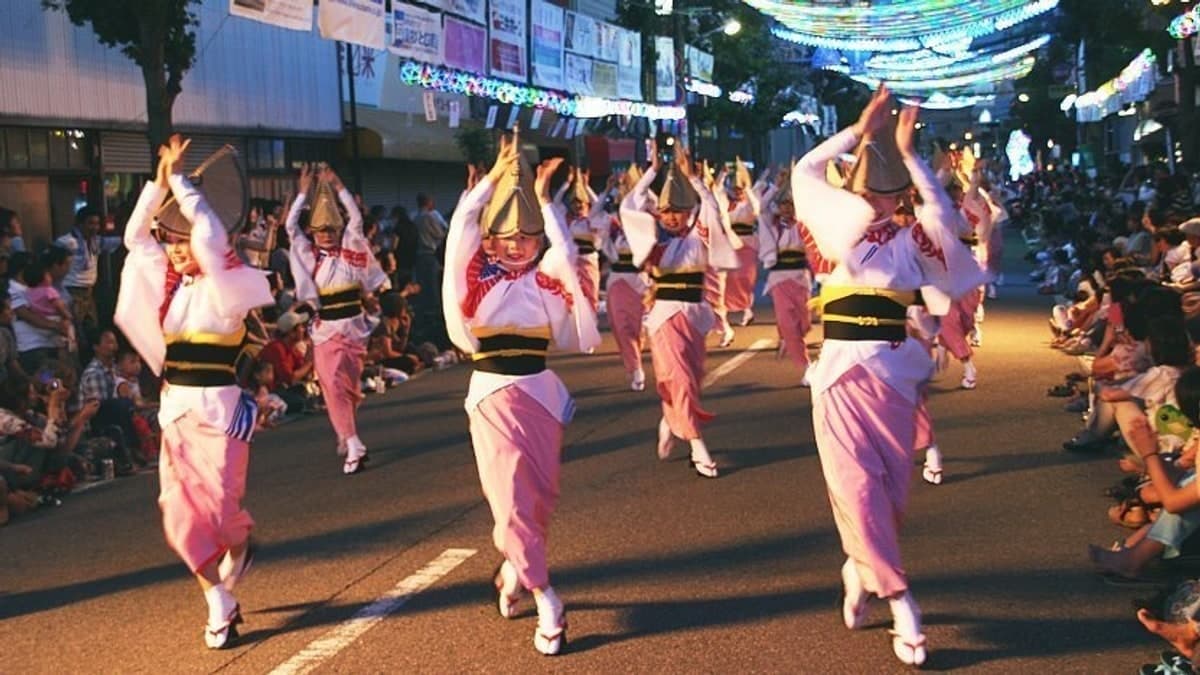
Bon odori — community dances performed during Obon — can look like celebration to outsiders. And in a way, it is. Not because grief is ignored, but because sorrow and gratitude can share the same evening air. Movement, music, and gathering bodies in rhythm remind mourners they are not isolated in loss.
Many Western services keep grief still and solemn. That has its place. But joy and remembrance are not betrayals of grief — they can be expressions of a life fully lived.
To borrow: Include music the person loved — even if it makes people smile. Invite a sing-along, a group photo, a story circle where laughter is allowed. When pre-planning, say explicitly if you want your service to feel more like a gathering than a lecture. Honesty about tone prevents a ceremony that feels colder than the life it honors.
5. Clean and Care for the Physical Place of Memory
Before Obon, families often tend graves — washing stones, clearing weeds, replacing flowers. It is maintenance as devotion. The dead have a location in the world, and the living keep showing up for it.
Whether a grave, an urn niche, a tree planted in someone's name, or a bench by the sea, places need tending. That tending gives grief somewhere to go on days when words fail.
To borrow: Choose a memorial location with intention, and build care into your plan — who might visit on anniversaries, who keeps the space alive with flowers or small notes. For scatterings, identify a return spot: a bench, a trail marker, a family album. Memory benefits from an address.
6. Let the Season Return — Every Year
Obon is not a one-time event. It comes back. The calendar itself becomes a companion to grief, offering rhythm instead of rupture. Anticipation replaces the pressure to "finish" mourning by a socially acceptable date.
You don't need a religious festival to want the same thing: a recurring invitation to remember, rather than a single day after which silence is expected.
To borrow: Mark anniversaries in your plan — not just the date of death, but birthdays, favorite holidays, or a chosen "remember me" day. Tell loved ones: I want you to gather again. Grief research consistently shows that ongoing connection, not abrupt closure, supports healing. Permission can be planned.
The Real Takeaway
Obon endures because it answers a human need older than any single culture: the need to remain in relationship with those we have lost — not through denial, but through ritual, food, light, and return.
The deeper question it opens is worth sitting with: What would it mean for a farewell to be recurring rather than final? Not endless sorrow — but honest remembrance, welcomed on its own schedule.
So keep exploring. Borrow freely and thoughtfully. Let curiosity lead you toward a ceremony — and a life after it — that feels genuinely, unmistakably yours.